.jpg)
Showing posts sorted by date for query shade. Sort by relevance Show all posts
Showing posts sorted by date for query shade. Sort by relevance Show all posts
Sunday, May 16, 2021
Zone Five and a Half: Best Shade Annuals
Friday, June 12, 2020
Why Are The Leaves of Plants Turning Yellow?
 Yellow is not mellow when it should be green. Why are the leaves of my cleome yellowing? When plant leaves fade to gold, the first culprit is lack of sun. The other causes are not as obvious.
1. Mulch: Well intentioned gardeners who mulch heavily with shredded hardwood may notice discoloration of the leaves of annual flowering plants. During spring rains tannins from the wood leach into the top surface of the soil and are absorbed by the roots of young plants, especially annuals. The result may be yellowed leaves, especially at the base of the plant.
 2. Too much sun: New plants, especially those grown in a greenhouse may discolor in the full sun. It's best to plant new growth during the rainy overcast days of spring or fall to minimize stress on the plant. If that's not possible, shield the plant with cardboard or a partially (but not fully) tipped dark plastic pot for a few days. The plant will eventually adjust to sunlight.
3. Moisture stress. The most common cause of yellowing leaves is too much, or too little water. Plants all have different water requirements. First look up the actual needs of a specific plant. Most full sun plants require more water than shade lovers. Overwatering in the shade also leads to fungal infections. Best measurement is still by touch. Poke a finger into the surrounding soil. It should feel damp but not soaked. If the area is powdery, then water. If it is soupy, wait until it drains.
4. Inadequate drainage: Heavy clay soils cause water to pool. The top of the plant's root ball may appear to be adequately watered, but clay substrate causes water to accumulate below the surface, at the roots. If the yellowing plants are in a pot, drill drainage holes, or tip the pot on its side onto the grass allowing stagnant water to drain.
5. Fertilizer burn: Well meaning gardeners often treat yellowed leaves with heavy doses of fertilizer. Unfortunately, no amount of fertilizer will help an ailing plant. The added introduction of plant stimulants only causes further plant stress. Even healthy plants (and grasses) will turn yellow if too much plant food is applied. It's better to introduce weaker, more frequent doses, if needed.
 6. Chemical over-spray: Droplets from lawn or tree chemical spraying can attach to the leaves of annuals or perennials and cause burning of the leaves. Water the garden heavily after a visit by Lawn Green, directing the water spray at leaves-rather than roots.
7. Nature: Some plants simply turn yellow earlier than others, and before the official start of fall color. Bleeding heart, for example, turns yellow in mid August. Hosta begins to age in early September.
 There's no spray or plant pill for yellowing leaves. Remove those that have turned--they won't return to the green zone. If the base of the plant remains healthy, perennials will likely return the following year.
 If the issue is be cultural, relocate, shelter, adjust watering or fertilizer practices.
Yellowing leaves are unavoidable.
 They're how plants communicate their displeasure with us.
 Related topics:
Why Are the Maple Leaves Brown?
Will My Garden Survive This Drought?
Thursday, March 12, 2020
Impatiens 2020 -- Give Them A Grow!
 |
| Imara Impatiens |
Since the outbreak of the insidious downy mildew seven years ago, impatiens have been persona non grata in the garden. The resurgence of the disease year after year caused the busy lizzie to fall in popularity.
 |
| Imara Impatiens 2019 |
Last year Imara Impatiens were introduced into the U.S. market in limited quantities. Flats were pricey--at my midwest farm market, the cost was about double the price of "ordinary" impatiens.
But these flowers performed well, mounding and filling in like their predecessors. No sign of downy mildew.
Imara are indistinguishable from traditional impatiens. Colors are limited, but that may change with the passage of time.
There was a bright side to downy mildew. It caused gardeners to diversify and familiarize themselves with alternative blooms like begonia, coleus and vincas.
It's lovely to welcome back an old friend to the garden, while keeping the new close at hand.
Related posts:
Imara Impatiens Review 2019
Bye Bye Bizzie Lizzies - What to Plant Instead of Impatiens
Best Midwest Shade Annuals
Thursday, July 18, 2019
Imara Impatiens Review 2019
Is there a spore or disease resistant strain of impatiens that can beat downy mildew?
The jury's out.
Since the widespread outbreak of the insidious downy mildew six years ago, impatiens have plummeted in popularity. Once the top shade annual in most European and U.S. gardens, the resurgence of the disease year after year caused the busy lizzie to fall in popularity.
Introduced in Europe in spring trials for 2018, Imara has now come to the U.S., and is offered in limited quantities.
In Swahili, the term Imara means "strong" or "resolute."

 Planning to avoid traditional impatiens this year, I was intrigued by the appearance of a "disease resistant" strain at the county farm market. After plopping down thirteen bucks for a flat of Imara impatiens let's hope the plants not only thrive--but plant themselves!
Bred from seed, Imara claims to be "The first impatiens walleriana with a high degree of resistance to downy mildew." The grower also promises Imara will flower earlier and last longer to frost"--but only time will tell.
There is no difference in appearance from the former moldy variety.
Individual plants look healthy and full. In the ground for a few weeks, there's no sign of disease.
.
 So it it time to "take back the shade?" Unclear, but "stand by" for further updates.
July 2019 update: Despite a very rainy June and July, there's no sign of downy mildew.
Fingers crossed.
More on impatiens plight (blight:)
Bye Bye Busy Lizzies. What to Plant Instead of Impatiens?
Impatiens Update 2019
The jury's out.
Since the widespread outbreak of the insidious downy mildew six years ago, impatiens have plummeted in popularity. Once the top shade annual in most European and U.S. gardens, the resurgence of the disease year after year caused the busy lizzie to fall in popularity.
Introduced in Europe in spring trials for 2018, Imara has now come to the U.S., and is offered in limited quantities.
In Swahili, the term Imara means "strong" or "resolute."

 Planning to avoid traditional impatiens this year, I was intrigued by the appearance of a "disease resistant" strain at the county farm market. After plopping down thirteen bucks for a flat of Imara impatiens let's hope the plants not only thrive--but plant themselves!
Bred from seed, Imara claims to be "The first impatiens walleriana with a high degree of resistance to downy mildew." The grower also promises Imara will flower earlier and last longer to frost"--but only time will tell.
There is no difference in appearance from the former moldy variety.
Individual plants look healthy and full. In the ground for a few weeks, there's no sign of disease.
.
 So it it time to "take back the shade?" Unclear, but "stand by" for further updates.
July 2019 update: Despite a very rainy June and July, there's no sign of downy mildew.
Fingers crossed.
More on impatiens plight (blight:)
Bye Bye Busy Lizzies. What to Plant Instead of Impatiens?
Impatiens Update 2019
 |
| Imara going strong August 2019 |
Friday, January 25, 2019
Busy Lizzie or Bust? Should I Plant Impatiens in 2019?
Is it safe to plant impatiens this year?


Appearances can be misleading. If nursery shelves are any indication, then impatiens walleriana seem to be a go this year. Downy mildew has now plagued this staple of the shade garden for at least a half dozen years. Sadly, the disease shows no signs of letting up.
Yet it's tough to pass up those lovely flats of pinks and salmons each spring. But robust, healthy looking plants may whither before season's end, leaving the garden barren when it should have been poppin'.
 Cautious gardeners following expert advice held back from planting colorful bizzies for the recommended three years--only to find that the disease had either remained in the soil or the dastardly spores had hitchhiked in on new purchases.
 Experiment or adapt. Versatility is the mainstay of gardening.
 Cautious gardeners following expert advice held back from planting colorful bizzies for the recommended three years--only to find that the disease had either remained in the soil or the dastardly spores had hitchhiked in on new purchases.
Thus, in 2019, proceed with caution. At the shop, inspect the undersides of baby plants for spots or dots. Plants in drier areas or locations which did not host infected plants in prior years. Impatiens mildew is a water mold. Irrigate in the morning to avoid moisture clinging to leaves overnight.
Give it a cautious go if you must, and hope for the best.
 |
| Begonia Shade Border |
Impatiens are tropical natives. The tiny seeds are difficult, but not impossible to start. The moist environs of a greenhouse makes it a good host for killer spores.
Downy mildew only affects one breed, impatiens walleriana,
Plan B calls for substitution of colorful alternatives:
 Experiment or adapt. Versatility is the mainstay of gardening.
Made for the Shade:
Wednesday, October 31, 2018
Best Shade Annuals

WHAT ARE THE TOP ANNUALS FOR SHADE GARDENS?
Annuals are one season showstoppers.
Typically native to warmer climates south of zone eight, annuals flourish in the summer months then die back after the fall frost.
Unlike perennials, which survive the winter months reappearing in late spring, annuals quickly establish, then bloom until frost.
 |
| New Guinea Impatiens are disease free |
Choices are limited for shade gardeners craving some color, but blooms that thrive in full to partial shade are readily available.
1. Impatiens: Fabulous, but risky. The moldy blight overwinters and could take three to five years before it clears out. Replanting risks a return to the starting block. If planting make sure the area is well drained.
2. Begonia: Does well in dappled shade. More disease resistant. Chose a variety with green leaves
as burgundy and brown stems don't show as well. White pops in the shade. Pink and red blooms are smaller and do not show as well. In the fall begonia become a mounding beauty, with a spectacular show before the cold sets in. Die back in late fall is quick. Removal is easy as roots are minimal.
2. Coleus. Fast becoming a favorite, coleus comes in a plethora of beautiful jewel tones. Great for the border.
3. Minimulus/Monkey Flower: The white blooms are small, ringed in soft purples and pinks and resemble tiny monkey faces. These rascals require little pruning.

4. Pansies: Deep, stunning and vibrant colors, these are hardy annuals. Die back occurs during the
hottest summer months. Cut back and move to a shady location for a second bloom in the fall. Pansies and violas often survive to spring if sheltered or following a mild winter.
Group in drifts or combinations throughout the yard or in pots.
 There's a peacefulness in the shade garden that cannot be measured by the sun.
In early spring, fall-planted bubs will naturalize and flourish before trees bloom.
 Observing a shaded garden from a sunny outpost, it appears monotonous. Not much color is needed, but adding a bit beckons the garden visitor to the coolness under the canopy.
Somewhat Shady:
Best Shade Perennials
Turtlehead and other Fall Bloomers
Friday, August 24, 2018
Finding Piet
CREATE YOUR OWN OUDOLF GARDEN
 Piet Oudolf transports the magic of the meadow to the heart of the city.
My first exposure to his work was accidental. Headed to Grant Park from our downtown Chicago hotel, we passed through an inconspicuous gateway into the Lurie Garden.
Oudolf's creation was in full bloom. Children padded through the trickling stream-like fountains. Tourists cooled their dangling feet--a respite from the scorching pavement.
 |
| High Line Park New York City |
Later, walks along the High Line near the Chelsea district of New York offered another view of Piet's creative work. An abandoned railway overpass was transformed into a pathway strewn with calming native plants with trees swaying in the Hudson River breeze. Thousands fill the walkways each day.
Soon Detroit will host a natural Oudolf wonder on Belle Isle--capitalizing on the force of the prevailing winds from the Detroit River at the mouth of Lake St. Clair.
 |
| High Line walkway |
The grounds around my home are (loosely) patterned after English gardens both formal and cottage in deference to the style of the home and the heritage of my beloved. No place for a pasture. But, like most gardeners, the plots expanded rather than contracted.
Two years ago a cottage garden replaced a tumble of ground cover at the base of a stone retaining wall. It was the perfect landing place for orphan plants, but filled out quickly, The addition of a gravel border path should have sealed the boundary, leaving the ramble weed hillside below untouched.
 |
| High Line in summer |
Piet Oudolf'design concepts are simple:
1. Use noninvasive native plants that will reseed freely and provide winter interest. No cutting back is required.
2. Follow the 70/30 rule. Seventy percent of the plants should be "fillers." Fillers such as grasses provide volume, height and movement. They are planted to provide the signature "haze" or "blur" that is the trademark of an Oudolf garden. Thirty percent of the plants should provide seasonal color through blooms or berries. Favored colors deeper hues of purple, red and gold.
 |
| Winter Interest High Line New York |
4. Plant in volume.
5. Repeat themes.
6. Plant in layers.
 |
| before |
At the end of season, vendors at the county farmer's market sell plants at a deep discount. The initial inhabitants of a pasture garden need not be pretty, only healthy. Thus the cranky vendor occupying the last stall nearly smiled at the offer of two dollars each for a couple dozen of astilbes and pampas grasses.
 Clearing the area was the most labor intensive part of the project. The largest and deepest taproot weeds were dug out by hand. Those with shallow roots required a stirrup or rake.
 |
| after |
Our little pasture is shaded so we chose astilbe and pampas grass for the fillers then catmint (nepeta) and variegated hosta as thrillers. More plants will be added in the fall as other plots are thinned.
FOUND GARDENS:
FREDERIK MEIJER SCULPTURE GARDEN
LAFAYETTE GREENS DETROIT

Thursday, June 15, 2017
Hot Plants -- How Midwest Plants Can Survive Extreme Heat

How much heat can a plant take?
She said yes! Then, the robust hydrangea planted in the yard in anticipation of the firstborn's wedding suddenly collapsed, brilliant blooms curling inward.
For the past week temperatures have topped ninety degrees by mid-afternoon. How can tender and newly planted flowers and shrubs survive this persistent heat?
 Water is essential, but not the only defense. Early morning watering helps, but if a plant is located in hot afternoon sun, it may still wilt. If wind accompanies the heat, supplement water intake with hydration. Direct a sold stream of H2O to the root and drip line of the plant. Water on the leaves could act as a magnifier in the hot sun--so minimize overspray.
 Some sagging isn't hazardous to the long-term health of a plant, particularly if it's well established. Plants, like people,
tend to droop in high heat, but normally the luster's restored as soon as temperatures are back in the seventies to mid-eighties.
Heat scorched leaves may be unavoidable and should be snipped away. They won't hurt the plant, clipping only improves aesthetics and promotes regrowth.
Nevertheless, more than a couple days of significant wilt ,( i.e. reduction of the plant to less than a third of normal height) can be deadly.

Once the heat wave passes, trim any permanent damage and increase water for a few weeks.
Don't fertilize until the plant is back in fighting shape.

By the time fall nuptials occur, the hydrangea should be big and blooming.
But all eyes will be on the bride ...
Hot Topics:
Rockery and Roll -- Xeriscape Gardening
Will My Plants Survive This Drought?
Saturday, January 14, 2017
Losing Impatiens in 2017
 |
| In 2018 impatiens blight is likely to return |
Seems the balsam blight has tucked in.
Despite the hope that downy mildew would fizzle after a three year quarantine, impatiens remain diseased after four years.
 Good garden practices can't overcome the trifecta of nature. Cooler temperatures, wet springs and cold winters create a susceptible host for the pathogen. As a water mold, impatiens blight thrives in cooler humid environments in the range of 59 to 73 degrees. Once infected,
 midsummer heat is no antidote for these tender annuals.
It's not difficult to be seduced by full flowering flats each spring. It's simply not worth the cost and effort to purchase and plant annuals which may not survive the season, and could contaminate the surrounding soil to boot.
As soon as the signs of blight appear {drooping leaves, tiny white flecks on the underside} there's no going back. There's no cure. Pull the plants out and dispose of them far away. Do not compost.
 |
| Begonias are the new impatiens |
While the busy lizzie blight is not transferable to surrounding plant species, it is recommended that plants within a three foot radius be removed. Still, I can't bring myself to remove a healthy plant simply because of unruly neighbors.
Avoid the grief--it's far less frustrating to plant fill the yard any of number of colorful alternatives:

What to Plant Instead of Impatiens?
Should I Plant Coleus Instead of Impatiens?
Begonias are the New Impatiens
Plants That Thrive Where the Sun Don't Shine
Wednesday, June 1, 2016
Cottage Garden ~~ Best Cottage Plants and Design

 1800's. Villagers collected native plants in the wild or sowed seeds and cuttings from neighboring yards. Upstarts were planted around the front pathway, along fences or hedges, packed in a dense and chaotic beauty.
 Flowers became the currency of kindness for those unable to purchase gifts. If that currency came with roots, the gift became a legacy.
Mid-century folks didn't have time to tend gardens, which often included edible herbs and flowers. Gardens were expected to be self sufficient. Plants weren't thinned and grew in thick masses, acting as a support, flopping against one another.
Inspiration can occur without warning, in odd places. (This one in the ladies' room of a nearby greenhouse.)
Design may start with a single idea, object or inspiration. A friend planned her living room renovation around a small blue porcelain egg, toting it in her handbag to paint stores, furniture showrooms and carpet sellers.
At the local greenhouse, "opening day" typically occurs on a chilly, drizzly April morning, when gardening without a pickax and layer of fleece is difficult to imagine. The only warm spot in the garden center at that time of year is the water closet.
 On the wall of the ladies' lounge hung an inexpensive print of a weathered bench centered in a garden reminiscent of England. The print wasn't of unusually high quality, which, given its location was to be expected, but there was something about the peaceful scene, and that worn bench, which urged me to reconsider an overgrown and distant portion of the yard. I snapped a fuzzy picture of the poster.
While I adore British cottage gardens, (and Englishmen) for that matter, I'd never considered planting one of my own. Must be their "unruly" nature. (The garden, not the husband.)
Yet, I couldn't shake the nagging inspiration. Once faced with those spilling blooms in that grainy poster, I was besotted--and obsessed.
I already had the bench.
There's always an abundance of healthy plants in the wrong places--lilacs now overshadowed by extended shade and leafy hydrangea shrubs no longer inclined to bloom. Toss in clumps of lilies, iris, and hosta along with the rest of the usual suspects.
 With proper planning, a root ball precutting would've been ideal, but advance notice is rare in the garden. Thus, we cleared the space--no easy task. Using an iron pitchfork to loosen the ground, most roots were coaxed out by hand.
 Next, the outline was defined. The garden hose was too stiff in the cold to offer much assistance. Historically, cottage gardens follow the outline of a wall, hedge or path. The chaotic nature of these gardens require a frame. Ours was a concave boulder wall.
Loosen the soil and rake smooth.
Cut a botanical edge to limit intrusion by grass and weeds.
 The real fun begins with the choice and placement of heirloom flowers.
These classics do best with morning sunlight:
- Lupine
- Foxglove
- Daisies
- Coneflower
- Black Eyed Susan
- Lilies
- Campanula
- Cranesbill
- Rayflower
- Salvia
- Iris
- Bleeding heart
- Bee's Balm
- Poppy
- Peony
- Lamb's Ear
- Lavender
- Columbine
- Hollyhock

Plant specimen largest to the back, mounding in the front.
Fill in each inch!
To give perennials the opportunity to fill in, for immediate impact intersperse with vintage annuals:
- Begonia
- Cosmos
- Mimulus
- Geranium
- Snapdragons
- Pansies
- Cleome
- Evening stock
- Four O'Clock

There are no rules. Add a focal point or two--yet don't overdo. Outline with a woodchip or crushed gravel path.

 Then, take a well-deserved seat.
 Cheers!
Related articles:
How to Create a Natural Edge (for free!)
The Gardens of Downton Abbey -- Plant Your Own English Garden
Vintage Gardens ~~ Spider Plants and Fancy Pants
Saturday, February 6, 2016
Impatiens 2016 ~~ The Blight is Back
 |
| Impatiens 2017 are a "no-go" once again |
All appeared positive for the first warm months, as the yard had been clear of downy mildew for over three years. Sadly, by mid summer, the lizzies were looking less busy. Within weeks the mildew blight had returned.
In 2016 it's back to the reliable replacements of begonia and coleus in place of impatiens.
No worries! There are fabulous alternatives to impatiens for color in the shade garden:
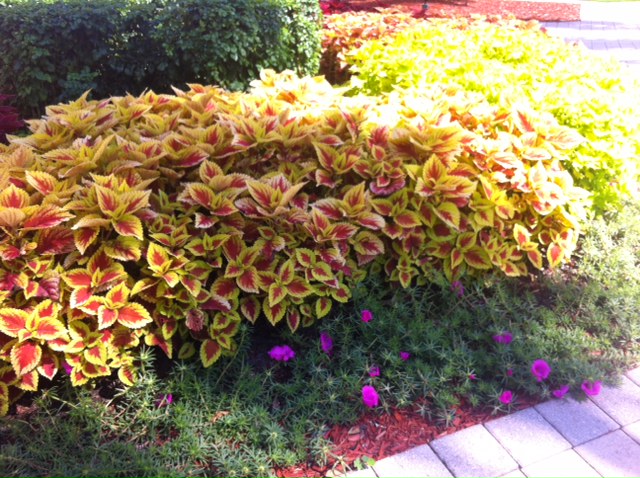 What To Plant Instead of Impatiens?
 Begonias Are the New Impatiens
Coleus Revisited Should I Plant Coleus Instead of Impatiens?
Impatiens Blight Disease -- Trouble In the Landscape
Bye Bye Bizzie Lizzies
 It'll be a long while before impatiens should be considered for the Midwest garden.
Subscribe to:
Posts (Atom)