Friday, May 11, 2018

Garden Gates

GATES ARE THE OPENING ACT

A fence is not required.  Garden gates stand alone, unite hedges or define a pathway. 

The gate can be made of any material, wood, willow, iron or copper.

A gate can be functional, keeping intruders out,
or occupants in.  Or it can be purely decorative.  From simple creations to elaborate works of art.

Gates know no language, they are impervious to cultural or political influences. They can be shabby or grand.  Always charming.


Gates are the cherry on top of a lovely sundae of a garden.

They may creak, or lean, but gates always add an element of interest, whether open or closed.

They  offer mystery and inquiry.  Doorways to the beauty within.


Single or double the message is the same.  While fences create boundaries, gates are an open nvitation.


In my travels, I've paused in front of innumerable entryways, wondering about the gardens they protects, and the gardeners therein.


Sometimes the latch opens easily. 

Curtain's raised!

And the magic begins...


Beyond the gates:


The Garden Potting Bench

Cottage Garden Design

Thursday, March 15, 2018

How to Make Natural Plant Supports ~~ Branch Trellises


How to make a plant trellis
Internet search hit success depends upon finding the exact word or phrase to describe the indescribable.  In the quest for "rustic wood plant support thingies that kind of look like a teepee," Google images led to trellises with the French term tuteur meaning "guardian."  

How perfect!  The upright guardian of plants, formed by the cast off branches of trees. Poetic, organic and cheap.

For the price of a roll of twine, floppy plants and flowering vines can be protected in style:

  1. Gather interesting, sturdy detached branches. They don't need to be perfectly straight and uniform. 
  2. Precut a length of twine and grab some twist ties.
  3. Choose five compatible candidates and form a teepee, joining the branches about one-quarter of the way from the top.
  4. Trim the branches so they are even top and bottom.
  5. Join them at the top intersection with the twist tie then overwrap the intersection with twine. Trim.
  6. Install tuteur into the ground or pot over the baby plant.  Evenly space the bottom of each support.  Plant firmly in the soil. Adjust until even.
As an alternative to twine, use dried vines. 

Went a bit crazy that first year with the tuteur trellises, but they're nearly free, easy and add a rustic flair. 


Save more green:

Free Mulch and a Cuppa Joe

Window Boxes Gone Wild!

Sunday, January 28, 2018

Fall Leaves Still on Trees?

Maple Tree Disease
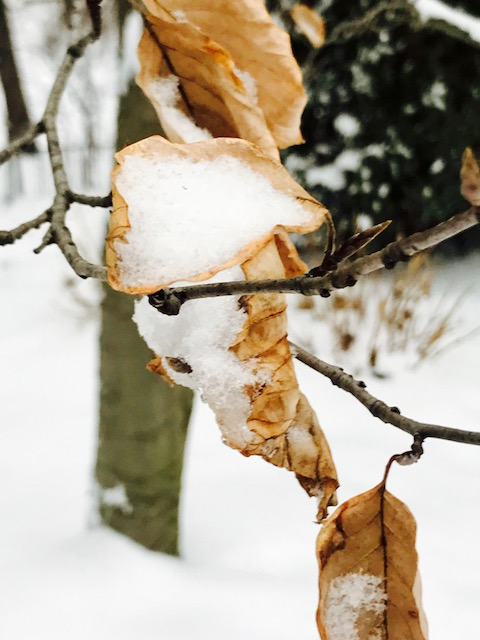
The maple's at it again.  Rather than toss her fiery crimson leaves to the ground after the final frost, the Japanese maple has clung stubbornly to withered brown leaves  through this brutal, snowy winter.

The maple in the front fared about  the same, as did the neighbor's pair of flowering pears. 

I found that reassuring. It's unlikely varied and mature trees would suffer simultaneous disease.

Spring's yet to sprung, but it appears that the shaggy trees are the result of an early cold winter.

In southeast Michigan, the "first widespread frost event" of 2017 was reported on October 26th.  The Old Farmer's Almanac calculated the probable date as October 30th, using 1981 to 2010  average "Climate Normals."

Usually the decrease in daylight along with a gradual freeze
allows a tree to begin the gradual process of discoloration coupled with the tightening of the ring at the base.. of each leaf.  The tree, in her own deliberate way, schluffs off her leaves each fall.

In the fall of 2017  the frost was early and hard,
and many trees simply retired ahead of schedule --becoming dormant before the job was completely done.  What's left are muddy looking leaves.

Not to worry.  In the spring, new leaf buds will finish the job, and toss last year's to the ground.

And you thought you were done with fall clean-up?

Grab the rake!

still hanging on: